
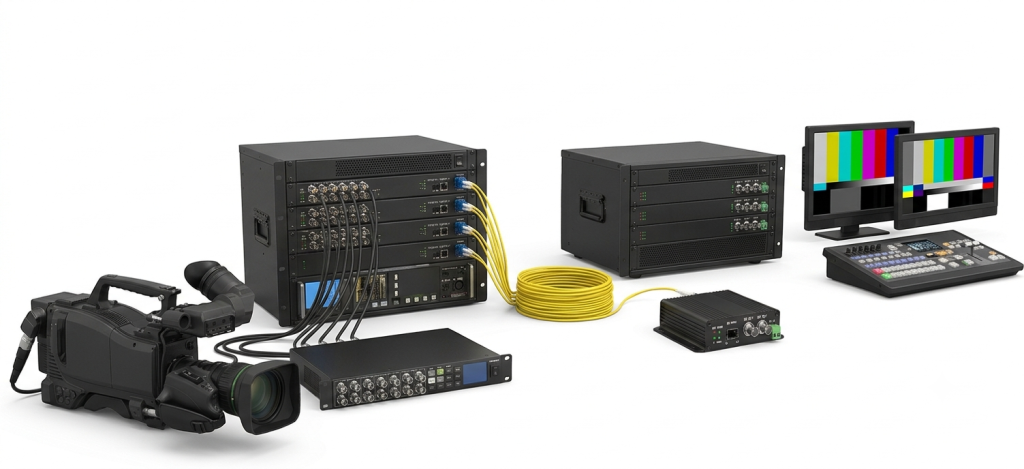
SDI (Serial Digital Interface) is the cornerstone standard in the broadcasting and television industry. Its fiber optic conversion system must meet stringent requirements for real-time performance, reliability, and interoperability, and is the core infrastructure for on-site production, broadcast control, and satellite transmission.
Standard System and Bandwidth Evolution: The SDI standard defined by the SMPTE organization has continuously evolved with the increase in resolution: SD-SDI (SMPTE 259M, 270Mbps) is used for standard definition, HD-SDI (SMPTE 292M, 1.485Gbps) supports 1080i, 3G-SDI (SMPTE 424M, 2.97Gbps) supports 1080p, 6G-SDI (SMPTE 2081) and 12G-SDI (SMPTE 2082) respectively support 4K@30Hz and 4K@60Hz. Fiber conversion requires strict matching of rate grades. The 12G-SDI optical transceiver is backward compatible with lower-order formats, but the opposite is not possible.
Broadcast-level technical requirements: Jitter performance is the core indicator. According to the SMPTE standard, the jitter of 12G-SDI output should be less than 0.3 UI (unit interval). The optical transceiver must have a built-in low-jitter clock recovery circuit (usually using LC VCO or silicon crystal oscillator PLL); The bit error rate should be better than 10⁻¹², corresponding to the optical receiving sensitivity should be better than -18 dBm (for 12G-SDI). The system should reserve more than 3 dB of optical power budget; In terms of ANC data transmission, the audio embedded in SDI (up to 16 channels), time code (VITC/LTC), and subtitles (OP-47) must be transmitted without loss. The optical transceiver must not recalculate the CRC check code; The cable simulation function allows the optical transceiver to simulate the characteristics of a specific length of coaxial cable to ensure impedance matching with the downstream equipment.
System architecture design: The point-to-point architecture is used for direct connection between cameras and the switcher, employing a single-core bidirectional (BIDI) optical module, and transmitting video, return video (Return Video), and internal communication (Intercom) through WDM technology within a single optical fiber; The ring network architecture adopts CWDM or DWDM technology, carrying multiple SDI signals on a single optical fiber (such as 40-wave DWDM can transmit 40 12G-SDI signals), and combining with optical add-drop multiplexer (OADM) to achieve flexible routing of nodes, suitable for matrix systems of broadcast vehicles and overall broadcast control; The hybrid IP architecture converts SDI to IP streams through SMPTE ST 2110 gateway, and supports seamless switching protection (SMPTE 2022-7) during fiber transmission, which is the mainstream trend for 4K/8K ultra-high-definition production and broadcasting.
Key equipment selection: The camera base station (Camera Base Station) should be chosen with models that support fiber power supply (PoF) and remote control (RCP). The single-mode fiber transmission distance can reach 10 kilometers. It is recommended to use multimode fiber (OM4) inside the broadcasting vehicle with 12G-SDI optical transceiver to simplify cable management. The broadcasting link must be equipped with 1+1 optical protection switching equipment, which complies with the broadcasting safety broadcasting regulations. With the popularization of SMPTE ST 2110-22 (JPEG XS compression) and ST 2110-30 (audio) standards, SDI over IP optical gateway is gradually replacing traditional baseband optical transceiver, but SDI fiber direct transmission still cannot be replaced in scenarios with ultra-low latency (<1ms).